Video podcast for business with a camera-shy guest: behind the scenes at GUMAC Franchise
A video podcast for business when your speaker is camera-shy: behind the scenes of the GUMAC Franchise shoot and how Nite keeps guests relaxed and natural.
Plenty of business leaders have a lot worth sharing, yet the moment a camera appears, the words freeze. That was the starting point of a video podcast for business Nite produced for GUMAC Franchise (GUMAC Nhượng Quyền). This post looks back at the shoot through the client’s own words and behind-the-scenes photos, plus what Nite has learned about helping camera-shy people speak naturally.
What the client said
“The Nite team was professional and easy to work with. I’m usually camera-shy, but they made me feel comfortable enough to simply talk and share, so the whole shoot felt natural.”
Kelvin Nguyen, Chief Strategy Officer, GUMAC
“Usually camera-shy” is probably the phrase Nite hears most on any project where real people talk on camera. The second half, “comfortable enough to simply talk”, is exactly what the crew aims for: turn the shoot into a conversation, not a session of reading lines to a lens.
Behind the scenes: the setting and the gear
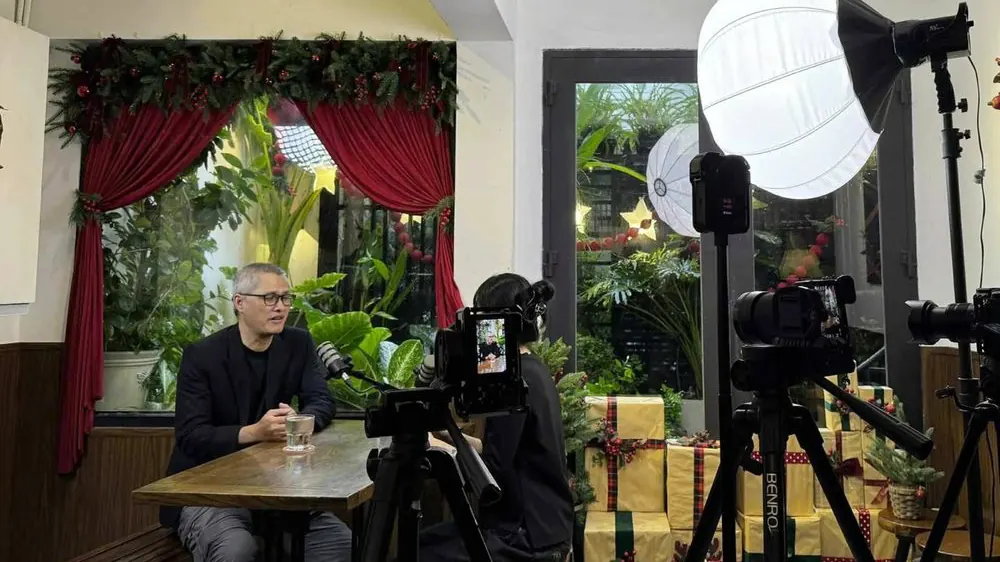
The cover photo is a real moment from the shoot. A few details worth noticing:
- A warm café-style space with plants, red curtains and seasonal decorations, rather than a meeting room or a plain backdrop. A familiar-feeling space makes it easier to forget you are being filmed.
- The guest sits across from the interviewer at a wooden table with a glass of water, just like an ordinary conversation.
- Three cameras on tripods at different angles, with lantern softboxes for soft light. Because several angles record at once, the guest only has to say something once instead of repeating answers for new angles.
- A podcast microphone on the table, clearly visible in the finished videos.
The finished work on the GUMAC Franchise project page is a set of vertical videos of about a minute each, mixing wide and close shots with bold titles and motion graphics, made for short-form video platforms.
Why camera-shy speakers relax when it is a conversation
In Nite’s general experience, the biggest pressure for people who rarely appear on camera is not the lights or the lens. It is the feeling that they must “say it right”. Asked questions as in a real conversation, they think about their story instead of the camera. A few things Nite usually does:
Talk before you roll
A relaxed chat before recording helps both sides get comfortable. The interviewer learns how the guest naturally explains things, and the guest knows where the questions are heading.
Ask open questions instead of handing over a script
Rather than a prepared paragraph to memorise, the guest gets open questions. First answers may not be tidy, and that is what editing is for. Real speech is usually more convincing than recited lines.
Let the speaker look at a person, not the lens
In a podcast layout the guest looks at the interviewer opposite them. The cameras are observers at the side, so there is less to be distracted by.
Keep the crew lean and the interruptions few
Gear is set up before the guest sits down. With several cameras running in parallel, there is less need to stop and reframe, so the story keeps its flow.
Video podcast for business: one shoot, many pieces of content
One advantage of the podcast format is that a single conversation can be cut into many short videos, each built around one idea. One of GUMAC’s videos, for example, opens with the title “Đừng khởi nghiệp một mình” (“Don’t start a business alone”), a message short enough to make viewers stop scrolling.
If you are considering a podcast for your company, prepare:
- The goal of the series: building the leader’s profile, hiring, attracting partners or sharing industry knowledge.
- A list of 5–10 topics your guest genuinely has experience to talk about.
- Your main channel: vertical clips for social, a long version for YouTube, or both. Decide before shoot day so the crew can plan camera angles.
- A setting that reflects your brand: an office, a store, or a space with its own character, as in the GUMAC shoot.
If your brand also plans content where people speak directly to customers, the live selling checklist has more tips on preparing speakers and scripts.
Frequently asked questions
Can someone who is not used to cameras host a podcast?
Yes. The conversation format is one of the easiest for people who rarely appear on camera, because they don’t have to look into the lens or memorise lines. As Kelvin put it, feeling comfortable with the crew is what made the shoot feel natural.
What do I need to prepare for a video podcast for business?
At minimum: a goal, a topic list, a distribution channel and a location. Cameras, lighting, sound and editing are the production crew’s job.
Should I publish the full episode or short clips?
It depends on your channels. Many brands do both: the full version for people who want the whole story, short clips to reach new audiences on social media.
Want a podcast for your brand?
Nite produces podcasts as part of its video production work, from shaping the questions and setting the scene to multi-camera filming and editing into short videos. Browse Nite’s projects, or contact Nite to talk through a podcast idea for your business, even if your speaker is “usually camera-shy”.
Need video for your brand?
Tell Nite about your project and we'll suggest the right format and process.